Wednesday, March 9, 2011

Chubby bees

We have data!


So far, the hive seems to have gained around 2lbs today! Will see how it goes by evening, but it's following the general pattern i expected:

[update! looks like almost 3lbs]

* morning: hive weighs less as foraging bees leave
* 11am-3pm hive gets heavier during peak foraging hours


the little ups and downs are probably artifacts of the imperfect temperature compensation, and its affinity for even numbered values. There's probably a mathy way to fix some of that, but it'll have to be post-processed. Maybe i'll just have to get a real temperature sensor installed.

the way it gets lighter in the morning may just be a compensation artifact, and may indicate that the foraging bees really don't weigh that much.

updated graph:

Monday, March 7, 2011

We're watching what they eat

I love data. graphs. trends. love it.

So when we started keeping bees, harvesting honey, etc, i had a need to know more about what was going on.

I was initially going to try and make a bee-counter camera, but it turns out the little computer i have isn't powerful enough for that. Too bad.

Plan B: Weigh them. Lots of people weigh beehives - heavier in general is better, and there are lots of ways to find out how heavy a hive is: tip them, put bathroom scales under them periodically, etc.

But i need more. I want to know how much it weighs all the time. I want a graph of this data. Know anywhere that sells scales made for beehives? That let you make graphs and check every minute or so? Me either.

So i built one! I made a scale for my hive which reports data whenever it is asked, which is currently about every minute.

Ingredients:
* a bathroom scale ($20 on ebay)
* a microcontroller (like an arduino, an attiny85) which i could talk to via USB.

I took the scale apart and used the strain gauges and analog bits from the scale, an opamp/instrumentation amp to amplify the tiny voltage that the scale provides, and hooked it into the ADC on the microcontroller. That all connects to a little 4 watt computer in the garage, which relays the readings to another computer which stores the data.

It's now sitting under the hive and making nice graphs. So far the hive hasn't changed much in weight in the day and a half it's been running.

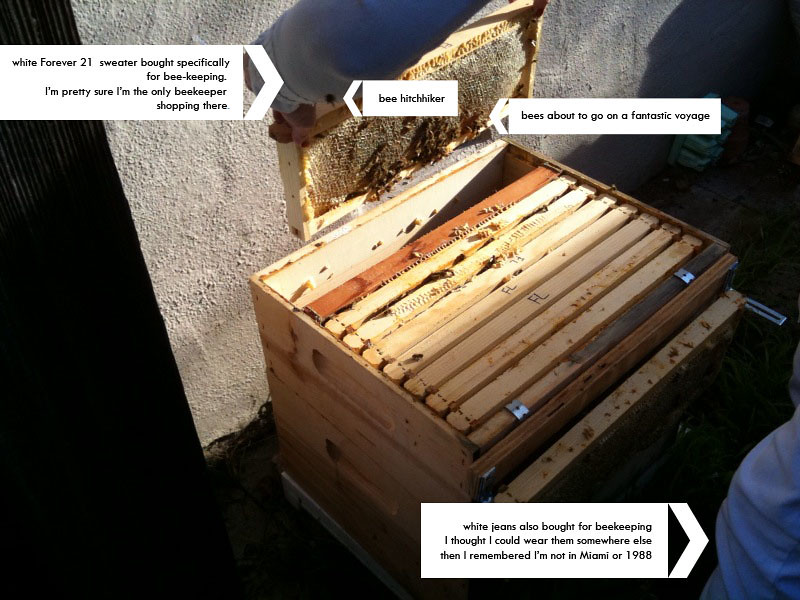
A couple pictures:


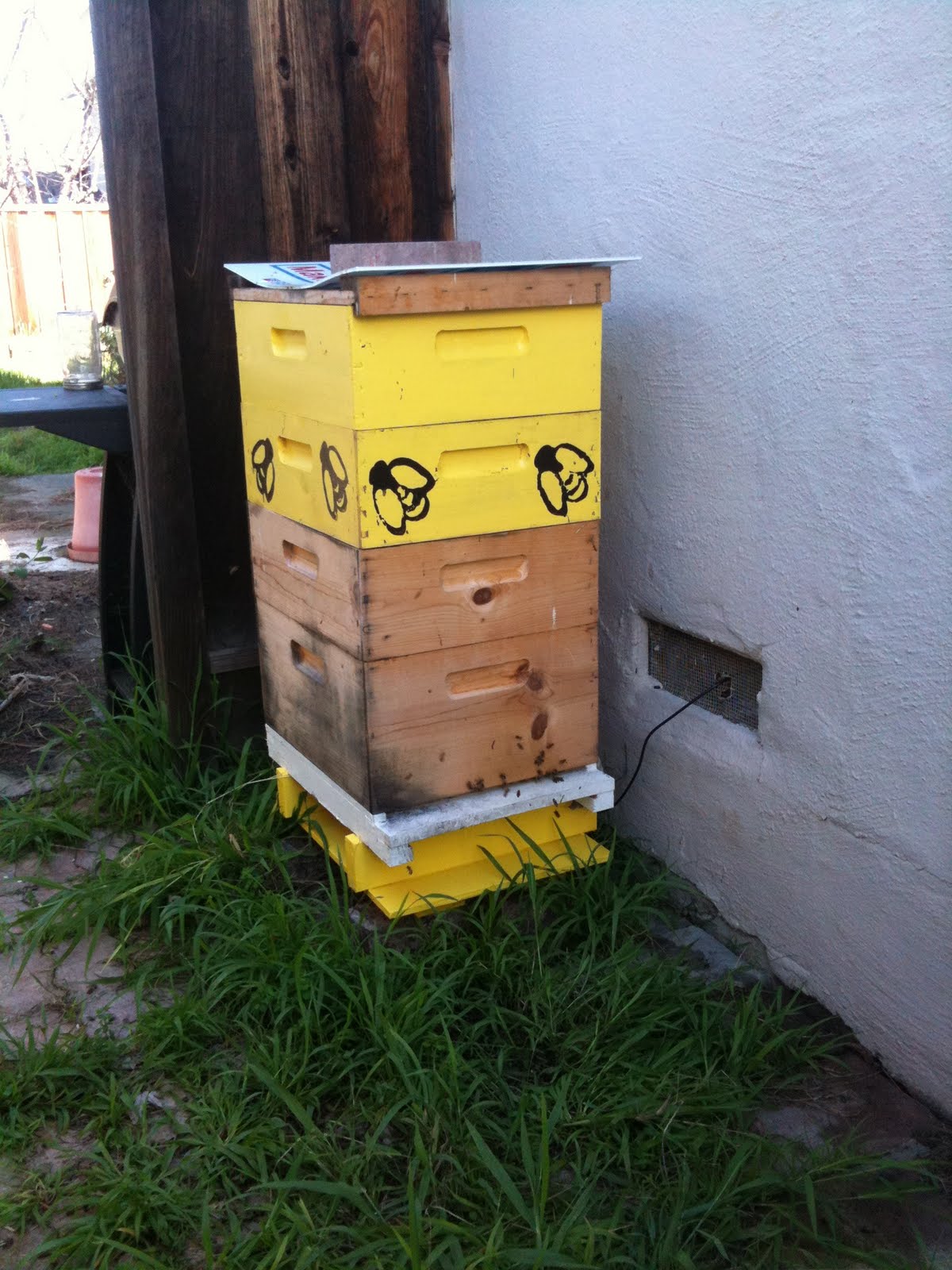
The scale is the yellow thing at the very bottom. Under the white base.

a graph:


The thick purple line (at the bottom) is lbs, and the other lines are used to calculate that one. The uptick at the very beginning is charlie replacing the plastic cover and the brick that holds it down.

The readings from the scale/microcontroller vary proportional to temperature, so i added some stuff to compensate for those swings. It's mathy so i won't go into it here. It works pretty well though :)

So, that's my hack for this week.

Sunday, February 20, 2011

New year, new bees

We opened the hive up for the first time this year to see how they are doing.

I didn't write down the date, but I think it was around Jan 21 or so.

Not much changed in the hive between Christmas (when we pulled honey), and that inspection.

Charlie did all the hands-on work, and I took notes and watched. We got some gloves for christmas, which she used. Good thing too, a bee stung the glove.

There were 3 full frames and 3 medium frames that had brood (i assume, they were covered in bees, which typically means they were keeping the grubs warm), so that shows that they're gearing up for the spring. This breed (carniolans) typically overwinters with fewer bees than italians, so having a small amount of brood is not terribly concerning at this stage.

Didn't see any hive beetles like last time.

Watching the entrance to the hive, they are quite busy, so that's good.

We pulled a black plastic frame that had BLACK wax on it, and was all funky looking. Wax tops were all wavy and there were rarely any bees on it. I let it sit in the garage for a day or so, and it smelled BAD. I threw it out.. didn't even want the bees eating the honey that was in it. I have a pet theory that it was the reason the bees didn't like that side of the hive, and that they will start thriving now that it's gone.

We had prepared a new super (box of frames) to put on the hive, and even though there was no new honey, we put it on anyways.

Here's how the hive is laid out now:

Hive body: 10 frames, all brood or honey (for insulation), active capped brood in 6-8.

First super, not painted:
1: F, capped honey (insulation)
2: Fresh foundationless frame added
3: FL, with fresh comb about the size of 2 hands
4: FL 80% drawn, some honey
5: FL with 2 tiny slivers of wax drawn
6: uncapped honey
7: brood
8: brood
9: Fresh foundationless frame added
10: F, capped honey (insulation)

Second super, painted with bees stamped on it
1: F, capped honey (insulation)
2: blank
3: some drawn some capped honey
4-9: FL, blank
10: Capped honey (insulation)

Top super:
1: F, capped honey
2-8: FL? blank
9: F, capped honey
10: FL, blank

No pictures this time, my phone got wiped :<

We moved the insulating honey frames around a bit so that all 3 boxes would have at least one frame of insulating honey on each side. Fresh frames were added next to the insulating ones in hopes that they would build out fresh comb there and fill it with honey. We'll see how it goes.

Wednesday, December 29, 2010

finally! produce! usefulness!...

...well okay the bees are useful year 'round to all the plants. But I like the kind of usefulness I can hold in my hand and/or eat.

We removed 3 frames (or how I still stubbornly refer to them as "panels" because thats what they look like) that were pretty full of honey and not much other stuff like pollen or "brood" (bee-grubs). I mean, who wants bee grub guts in their honey?, gross.

I was at the helm, gloveless and since that dayhad been pretty darn terrible already (long story, but quite horrendous) I was fully prepared to be stung, maybe even multiple times.

We got the frames out and tried to get the bees off them by bucket n' lid method, but after that proved ineffective, we just swept them off with a paintbrush and I scurried into the kitchen with them before the bees could give chase. Only a few had to be escorted out of the kitchen window back out into nature.
Then of course we had to get the honey out of the comb which involved a big knife and lots and lots of smooshing the comb. The smooshed wax and honey looks absolutely disgusting before it's filtered and separated. A dead ringer for barf, if not for the sweet/happy smell of honey.

Next that barfish-honey mixture sits in the mesh filter and bucket system that Kevin put together until it was all filtered and golden and supermarket worthy.

We scrounged up as many jars as we could, even one that I had saved with the intention of making a snow globe out of it (yeah, like that was gonna happen), and filled them up.

(that one jar had a label with NASA quality adhesive(!)

They were Christmas gifts, so we needed cute labels. And that's my speciality *flourish-and-curtsey*. So I modified my favorite bee logo and added some typography and well you can see in the pic what they look like.

Kevin is kinda obsessed with the crystallization of our honey. At what rate its crystalizing and to what degree. I am in turn obsessed with avoiding the universal stickiness that comes with honey. It's a supernatural force: the invisible hand of stickiness. Impossible to completely eradicate.

Well once the honey was all jarred we had the wax leftover, just as gross looking as you'd expect. It made me think of a certain mythbusters episode...*shudder*

Anyway, out I went to the Salvation Army store to buy a dedicated wax-pot (i.e., 'don't wanna boil spaghetti in any pot previously used for melting beeswax). And can I just tell you that the Salvation Army store on a wednesday night is like a scene from Cheers? I felt good about humanity after I left (and a nice grandma-lady told everyone I looked like Sandra Bullock, lol)

We melted it double-boiler style and then kinda-sorta filtered out all that extra heaven-knows-what-stuff (bee poop? bee parts? whatever it is, I don't even want it in my candle).


Then we poured it in a glass container with cotton strings weighted with steel washers.
It cooled, then we realized that there was water stuck at the bottom; squeezed that water out, and lit it.

Voila! Old timey candle. Biblical even! (although the ancient existence of washers is debatable).

Thursday, November 4, 2010

Inspection report 11/4/10

Given the wingless bees i discovered last week and the fact that i didn't do a full inspection, i decided to do a pretty full inspection today, and dust with powdered sugar too.

The powdered sugar does 2 things:
* makes the mites' sticky pads lose suction, so they fall off and out of the bottom of the hive (the hive as a screened bottom)
* makes the bees clean each other off which knocks mites off

Given the recent building out (and subsequent destruction) of the top bar in the upper super, i took stock of everything in the supers to see where we stand.

key:
F = foundation frame
FL = foundationless frame
T = top bar frame

Top super (in order, frame 1 - frame 10):
F - drawn, about 1/2 full of honey
FL - empty (no wax)
F - 1/4 drawn out with a tiny bit of honey
FL - empty
FL - hand size comb, no honey.. was not vertical, so i broke the bottom and realigned it.
FL - 4 half-hand size combs. Off center due to fat comb next door. doh.
F - Way fat and full of honey, some capped
F - Short cells due to neighboring fat frame. one side not drawn, one side has some honey
FL - empty
F - fat and full of capped honey

Lower super:
F - capped
F - capped
FL - half drawn, 1/4 honey
FL - 3/4 drawn, all that is drawn is capped honey
FL - full and capped
F - brood and honey. saw some eggs also (good sign!)
F - brood and honey
T - capped honey
FL capped honey
F capped honey

Here's how it compares to last time (10/10/10, about 1 month ago)

1: same (Capped honey)
2: same (Capped Honey)
3: same
4: fully capped now (plus 1/2 frame of honey)
5: fully capped now (plus 1/2 frame of honey)
6: same (brood)
7: same (brood)
8: a little more honey (fully capped now)
9: is now honey (was brood+honey)
10: same (capped honey)

so we've put on about a frame or so of honey since last time, and the bees have started moving to the upper super. One thing to note is that the bees seem to want to build the honey right above the brood.. the top bar in the upper super was directly above some brood, and the replacement got built out some right away (hand size piece of comb in 4 days).. I may use that slot as a comb-building slot.

I got stung about 2/3 through the middle box, and that took the fun out of the rest of the inspection: i didn't get to the bottom super at all. Stung on the pinky finger at 3:15pm, and by 5pm my whole hand and half my forearm is swollen. grr.

Update: midnight: arm from hand to elbow is swollen. darn bee.

I did dust for mites. I'll post the results of that separately.

cheers!
-tmk

Sunday, October 31, 2010

Oops, we have honey

Before today, the top super had basically been in the same state for the previous 3 inspections (about a month) - no real activity, few bees, no new comb, etc. This is not surprising, given the season is winding down, it's been rainy, etc. I didn't expect them to really do much in there till next year.

That top super is all foundationless except one or two frames. I don't think they've drawn out any of the foundationless ones (well, maybe one). There's one untouched top bar in there too. The middle super on the other hand has been getting more and more full of honey, and much heavier.

Today i went in with the intent of taking an inch or so off the sides of the top-bar i have in my lower super that the bees built out for me earlier this year - at last inspection it was almost all capped honey. I was thinking they wouldn't be building much new wax this year and it'd prevent them from sticking it to the sides. Plus we'd get some honey for all our trouble. More-or-less guarenteed to be local, since the top bar wax is new since it's been at our place, and while bees do move honey around sometimes, it's likely all the honey in there is local too.

I geared up, popped the lid, and pried the corners the second super to loosen it. As i lifted the box, it was a little harder to get off/more stuck than usual. I did some more prying with the hive tool (sometimes they stick it together more), then just pulled it off.

Much to my surprise, after i set it down and looked back, there was a frame's worth of comb filled with honey sticking up into the air! Apparently the bees not only drew it out (built comb) in the last 3 weeks, but also started filling it with honey and cemented it to the frame below. Must have been some sort of flow on. Funny, since i had been thinking with all the rain they would probably have been holed up and eating through their stores.

I didn't think they'd connect the top-bar comb to the frame below; I was under the impression that bees liked to leave a walkway at the bottom of the frames. Needless to say, i'll be removing the top bars from my lang (already swapped the one that tore out).

The upside is now we have some honey and some really nice fresh wax (there were a number of empty cells).. 1 lb, 4 oz is what we measured it at. That's about a little squeezy-bear's worth i think. We haven't tasted all of it, but some of it had a bit of an "earthy" aftertaste, similar to the way privet or photinia flowers smell.

Another issue which is getting more prominent is mites. When i smoked the bees off the comb that stuck/tore, some didn't fly away. When i looked more closely they had the deformed wing thing going on (maybe 3 or 4 bees). That's caused by a virus spread by mites. I'm pretty sure the crawling bees out front are caused by mites too.

Treatment plan: do another mite count and I'll probably dust them with powdered sugar next time I go in.

Can you taste it? (click for an even bigger version)

Sunday, October 10, 2010

Inspection report 10/10/10

Browsed through the hive a bit today.. not a much to report.. There's not a ton of nectar coming in, so i think the hive is in a bit of a lull.

Top super is still mainly empty, no real new activity there

Middle super is filling up with honey! Most of the foundationless frames that I put in are at least half built out and have some honey in them. Here's the frame-by-frame rundown:

1: Capped honey
2: Capped Honey
3: ~half built out, about 1/4 cells have honey, not capped
4: about 3/4 built out, half of the cells have honey, just a few capped
5: about 3/4 honey, some capped
6: brood with some honey mixed in
7: brood which looks like it just hatched out (didn't see eggs in there)
8: top bar was super heavy! mostly capped honey
9: brood and capped honey
10: capped honey

The new frame i put in the hive body is still pretty much untouched since the last time i checked. About a fist-sized bit of nice comb, but it looks totally virgin. I may pull it and put a comb guide in, the comb may be partially offset and that might be bugging them.

So the plan is to leave at least the outer two frames (1,2,9,10) with honey in them, and not to take any until that happens. I may slice the outer edges of the top bar off though and take that honey.. Get some payback and keep it from getting stuck to the sides so much.

-tmk